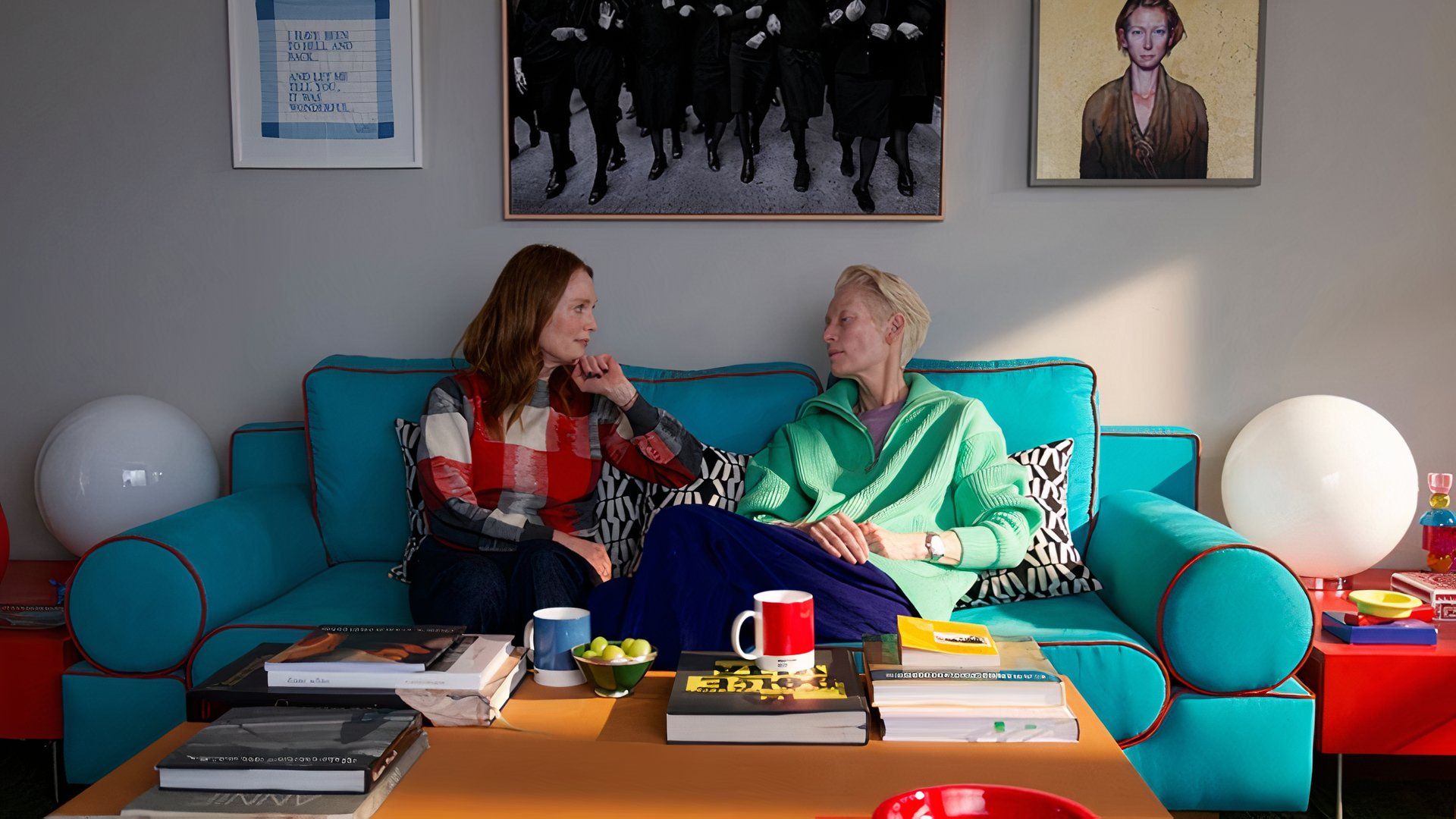
It is a weird feeling, sitting in a dark theater and realizing you are watching a movie about two people just... talking. No explosions. No multiverse glitches. Just Tilda Swinton and Julianne Moore in a house in Woodstock. The Room Next Door movie is Pedro Almodóvar’s first full-length English language feature, and honestly, it feels like a fever dream of high-end interior design and crushing existential dread. People are calling it a "masterpiece," but that word gets thrown around way too much these days. Let's talk about what is actually happening on screen.
Martha (Swinton) is dying. She has cervical cancer, it’s terminal, and she’s decided she wants to go out on her own terms. She reaches out to Ingrid (Moore), an old friend who is terrified of death. Ingrid wrote a whole book about how much she hates the idea of dying. So, the setup is basically a recipe for the most awkward vacation ever. They rent this stunning, ultra-modern house in the woods, and Ingrid’s job is simply to be in the room next door while Martha takes a pill she bought on the dark web.
It sounds grim. It is grim. But Almodóvar paints it in these hyper-saturated reds and blues that make it feel more like a painting than a funeral.
Why the Dialogue Feels So Different
If you’ve watched the trailer, you probably noticed the way they talk. It’s stiff. It’s deliberate. Some critics at the Venice Film Festival, where it won the Golden Lion, pointed out that the English feels a bit "translated." That’s because it is. Almodóvar writes in Spanish, and while he collaborated on the translation, he kept that specific, theatrical rhythm he’s known for in movies like The Skin I Live In or Parallel Mothers.
Most movies try to sound "real." This movie doesn't care about that. Martha and Ingrid speak in long, winding monologues. They recount old lovers and past betrayals with a clarity that no human actually has while they're drinking tea. But that’s the point. It’s a melodrama. It’s supposed to be heightened.
The Woodstock House is a Character
Seriously. The house they stay in is the "Liddell House" in real life, located in upstate New York. It is all glass, steel, and expensive-looking wood. In The Room Next Door movie, this architecture serves as a cage. Martha wants to die in a place of beauty, but the glass walls mean there is nowhere to hide from the reality of what’s coming.
✨ Don't miss: Questions From Black Card Revoked: The Culture Test That Might Just Get You Roasted
The production design by Antxón Gómez is almost aggressive. You’ll see a bright yellow couch against a deep green wall, or Julianne Moore wearing a pink sweater that matches the flowers in the background. It’s a visual feast that contrasts sharply with the fact that Martha’s body is literally failing her. It’s a reminder that the world stays beautiful even when we are leaving it.
The Controversy Around the Subject Matter
Let's be real: this movie is about euthanasia. That is a heavy topic. In the United States, "Medical Aid in Dying" (MAID) is legal in some states, but it remains a massive legal and ethical gray area in others.
Martha’s choice is portrayed with a sort of quiet dignity that has sparked a lot of conversation. She doesn't want a hospital bed. She doesn't want tubes. She wants a sunset and a friend in the next room. Some viewers find this empowering; others find it incredibly depressing or even morally questionable. Almodóvar isn't interested in a political debate, though. He’s interested in the intimacy of that choice.
A Quick Look at the Cast Dynamics
- Tilda Swinton (Martha): She plays two roles, actually. She plays Martha and also Martha’s estranged daughter, Michelle. The makeup work to make her look like a younger version of herself is subtle but effective.
- Julianne Moore (Ingrid): Her performance is all in the eyes. She’s the proxy for the audience. We are just as scared as she is.
- John Turturro (Damian): He plays a shared ex-lover who shows up to provide some intellectual context about the "end of the world," linking Martha’s personal death to the climate crisis. It’s a bit heavy-handed, but Turturro sells it.
The chemistry between Swinton and Moore is the only reason this movie works. If you didn't believe they had a history, the whole thing would fall apart. They have this shorthand that feels like two people who haven't seen each other in years but can immediately start talking about the most private things.
The Impact of the Golden Lion Win
When The Room Next Door movie won the top prize at Venice, it surprised a few people. Not because it wasn't good, but because it’s so quiet. It beat out much bigger, louder films. This tells us something about the current state of cinema. There is a hunger for stories that deal with the "un-dealable."
🔗 Read more: The Reality of Sex Movies From Africa: Censorship, Nollywood, and the Digital Underground
We spend so much time avoiding the topic of death. We hide it in hospitals. We use euphemisms. Almodóvar puts it right in the center of the frame, lit with 1,000-watt bulbs.
The film also marks a shift for Almodóvar himself. At 75, he’s clearly thinking about his own legacy and his own mortality. He’s moved away from the chaotic, colorful comedies of his youth (Women on the Verge of a Nervous Breakdown) toward something more meditative. It’s like he’s finally slowed down enough to hear his own heart beating.
What Most People Get Wrong About the Ending
Without spoiling the literal final frame, a lot of people walk away thinking the movie is "sad." I’d argue it’s actually weirdly hopeful. Not hopeful in a "she’s going to get better" way—because she isn't—but hopeful in the sense that human connection can actually make the impossible bearable.
There is a specific scene involving a pink snowfall. It’s a reference to James Joyce’s The Dead. "Snow was general all over Ireland." In this case, the pink snow represents a sort of surreal peace. It’s Martha’s imagination bleeding into reality. It’s beautiful, even if it’s a bit macabre.
The Real-World Context of the Story
The film is actually based on a book by Sigrid Nunez called What Are You Going Through. If you’ve read the book, you’ll notice the movie stays pretty faithful to the internal monologue, but it adds that "Spanish flair" that only Almodóvar can provide. Nunez is known for her sparse, intellectual prose, which perfectly matches the director's new, more disciplined style.
💡 You might also like: Alfonso Cuarón: Why the Harry Potter 3 Director Changed the Wizarding World Forever
It’s also worth noting the soundtrack. Alberto Iglesias, a long-time collaborator of the director, creates a score that feels like a Hitchcock thriller. This is intentional. It creates tension in a story where the "villain" is just biological reality. You find yourself leaning in, waiting for a jump scare that never comes. The "scare" is just the silence from the room next door.
How to Approach Watching It
If you’re planning on seeing it, don’t go in expecting a standard Hollywood drama. It’s slow. It’s talky. It’s very European in its sensibilities.
- Watch his older films first: If you’ve never seen All About My Mother or Talk to Her, give them a look. It helps you understand his visual language.
- Pay attention to the art: The paintings on the walls in the movie aren't random. They are carefully selected to mirror the themes of memory and loss.
- Go with a friend: This is not a movie you want to process alone. You’re going to want to talk about your own "Martha" or "Ingrid" moments afterward.
Honestly, the movie is a bit of a test. It tests your patience and your willingness to look at something uncomfortable. But in an era of "content" that is designed to be forgotten the second the credits roll, The Room Next Door movie sticks to your ribs. It’s uncomfortable, yes. It’s stiff, sure. But it’s also one of the most honest things put on film this decade.
Actionable Takeaways for Movie Lovers
To get the most out of this cinematic experience and the discussions surrounding it, keep these points in mind:
- Look for the "Edward Hopper" influence: The cinematography is heavily inspired by Hopper’s use of light and isolation. Notice how characters are often framed by windows or doors, feeling both connected to and separated from the world.
- Research the "Right to Die" movement: Understanding the legal context in New York versus other regions provides a deeper layer to Martha’s urgency and Ingrid’s legal fears as an accomplice.
- Analyze the color palette: Notice when the colors shift from vibrant to muted. It usually tracks with Martha’s energy levels and the progression of her plan.
- Read the source material: Pick up What Are You Going Through by Sigrid Nunez. Comparing the internal monologue of the book to the externalized dialogue of the film is a masterclass in adaptation.
This film isn't just a story about dying; it's a study on the ethics of friendship and the limits of empathy. It challenges the viewer to ask: "What would I do if my best friend asked me for the unthinkable?"